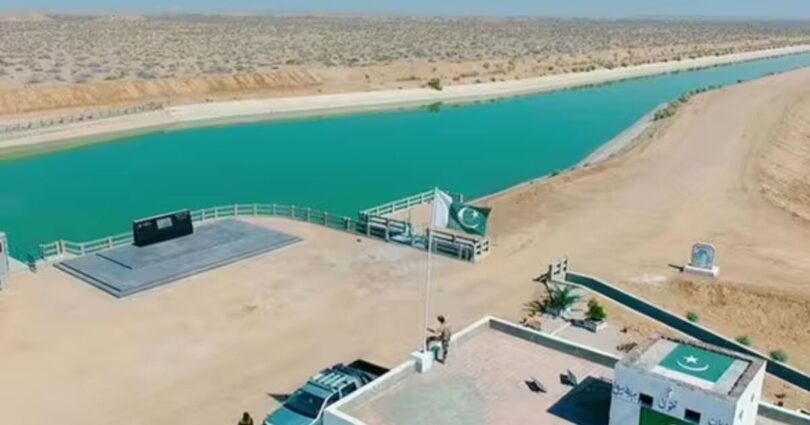
A country is spending £225 million on building a ‘mini-Suez’ canal. The Kachhi Canal Project in Pakistan will connect the Balochistan and Punjab Provinces with 310 miles of canal.
It will start at the Taunsa Barrage on the Indus River and end in Baluchistan, providing a sustainable irrigation water supply to 720,000 acres of farm land in Baluchistan and 30,000 acres in Punjab. The Pakistan Water and Power Development Authority has said that it hopes the canal will help to alleviate poverty and enhance employment opportunities in remote areas by encouraging more agricultural work. It said: “The main aim of the project is to irrigate agricultural production, resulting in a boost to the economy, improvements in the physical environment, including the atmosphere, climate, land, and water. It will also result in improvement in the quality of life due to betterment in socio-cultural and socio-economic conditions.”
The project was started in 2002 and was almost abandoned due to cost and time overruns. It is costing £225 million to build, but will benefit crops by an estimated £14 million a year.
The Kachhi Canal project is divided into three phases: Phase One totals 248 miles, Phase Two 37 miles, and Phase Three 25 miles. Phase One was completed in August 2017 and inaugurated in September 2017 by then-Prime Minister Shahid Khaqan. After completion, the canal will be 310 miles long. Baluchistan will get 121 miles of canal, and Punjab will get 189 miles.
During construction, as many as 914 structures, including head and cross regulators, road and railway bridges, cross drainage, escape structures, and watercourse crossings, have been built at or over the main canal.
Several revised deadlines for completing the project have been announced in the past, but the project is not yet completed, and work is ongoing at a slow pace.
The Suez Canal is an artificial sea-level waterway in Egypt, connecting the Mediterranean Sea to the Red Sea through the Isthmus of Suez and dividing Africa and Asia.
It was built between 1859 and 1869, having been created by a French diplomat. It was operated by a British and French company until 1956, when it was nationalised by President Nassar.
Source link