
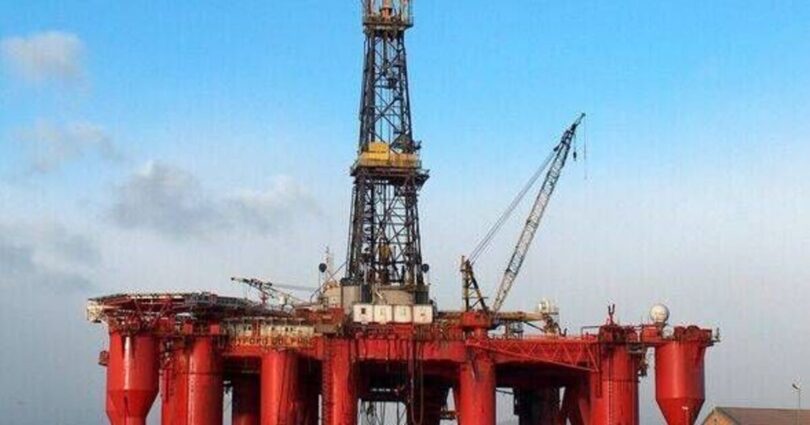
The Byford Dolphin oil rig in the North Sea (Image: Wiki Commons)
In a harrowing account, a catastrophic mistake which occurred beneath the ocean’s surface resulted in what have been described as some of the ‘most gruesome deaths’ in history, taking the lives of five out of six men involved.
The horrifying incident took place on a semi-submersible oil drilling rig where the divers were tasked with completing a deep-sea diving operation.
While the rig looked ordinary, it was tragically the location of multiple accidents involving its workforce throughout its years of service.
One such dreadful accident occurred on the rig in 1983.
The terrifying tragedy of 1983
The Byford Dolphin, a semi-submersible oil drilling rig, worked throughout the British, Norwegian, and Danish sectors in the North Sea, performing seasonal drilling for different companies.
In November 1983, a crew consisting of two British and two Norwegian divers – Roy P Lucas, 38, Edwin Arthur Coward, 35, Truls Hellevik, 34, and Bjørn Giaever Bergersen, 29 – alongside dive tenders William Crammond, 32, and Martin Saunders, 30, were positioned on the rig to execute a deep-sea diving operation.
At the moment of the incident, all six men were carrying out their responsibilities underwater, performing routine maintenance on the rig at a remarkable depth of 295 feet.

Illustration of the pressurised chambers and the divers’ position (Image: undefined)
To safely complete their work, the team were accommodated in special compression chambers for their scheduled 28-day period to prevent excessive nitrogen accumulation in their bloodstreams.
Within these chambers, the divers would inhale a precisely calibrated mixture of gases, usually oxygen and helium, modified according to the depth of their dive.
The team employed a technique called ‘saturation diving’, which allowed them to remain for extended periods at considerable depths below the surface.
This approach was used to ensure the crew could prevent decompression sickness, commonly referred to as ‘the bends’, when they rose to the surface.
The men used a specialised transport vessel, a diving bell, to safely travel between their living quarters and their underwater work site.
On 5 November 1983, divers Hellevik and Bergersen were completing a 12-hour shift, assisted by dive tenders Saunders and Crammond. They were returning to their sleeping quarters using the diving bell.
For the safe operation of the diving bell, it was vital that the crew ensured the transportation vessel was sealed and properly reconnected before they returned to their highly pressurised sleeping chambers. This procedure was necessary to prevent rapid decompression in the body, which could be lethal.
Once inside, the divers had to close the door and adjust the pressure in their sleeping chamber to create an airtight seal. This action would then isolate the chamber and connect it to the dive bell, which would gradually depressurise for the safety of the divers.
However, on that fateful day, the pressure in the inner crew chambers 1 and 2 (typically pressurised to nine atmospheres) dropped to one atmosphere within a split second.
This happened because one of the external divers committed a human error and released the diving bell prematurely before full depressurisation had taken place.
This blunder caused the clamp – which was maintaining the chambers sealed – to open before Hellevik had completely closed the chamber door.
Consequently, the pressure in the sleeping chamber suddenly shifted from that experienced at 295 feet underwater to surface air pressure, reports the Mirror.
Coward and Lucas were reportedly resting in chamber 2, under a pressure of 9 atmospheres when the devastating incident took place.
The sudden, powerful rush of air escaping the chamber caused the diving bell to be forcefully propelled, striking Crammond and killing him outright.
It is thought that three divers inside the sleeping chambers perished instantly as the nitrogen in their blood transformed into bubbles, essentially boiling them from the inside and reducing their bodies to innumerable fragments.
Hellevik, who was closest to the partially closed chamber door, was drawn through a narrow 60cm opening, resulting in his organs being expelled from his body.
The post-mortem report noted: « The scalp with long, blond hair was present, but the top of the skull and the brain were missing. The soft tissues of the face were found, however, completely separated from the bones. »
His abdominal and thoracic organs had been ejected.
Hellevik’s remains were reportedly transported for post-mortem examination in four separate bags retrieved from different areas around the rig. Each portion of his body within the bags of bone and tissue reportedly showed evidence of trauma.
Saunders, the sole survivor of the catastrophic incident, suffered serious injuries including punctured lungs, spinal fractures and a fractured neck.
The deadly incident was also attributed to engineering deficiencies. The Byford Dolphin oil rig was operating an obsolete diving system from 1975, which lacked fail-safe hatches, external pressure gauges or an interlocking mechanism.
This vital feature would have stopped the divers’ sleeping chambers from opening whilst the system was under pressure. Despite these inadequacies, the Byford Dolphin oil rig remained operational with modifications and transferred ownership until it was ultimately decommissioned in 2019.
It was subsequently sold for scrapping in the 2020s.
Source link