
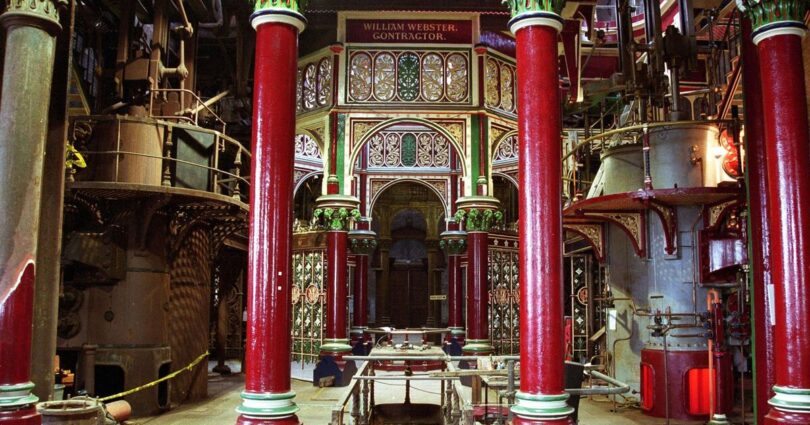
A building in southeast London that played a key part in Britain’s waste-management system is so beautiful on the inside that it’s described as the « Cathedral of Sewage ». Crossness Pumping Station is a former sewage pumping station at the eastern end of the Southern Outfall Sewer and the Ridgeway path in Bexley, southeast London.
The building was commissioned by Sir Joseph Bazalgette, the Metropolitan Board of Works’s chief engineer, known for creating the London Main Drainage, the sewerage system for central London. It was constructed over six years to Sir Joseph’s design by civil engineer and contractor William Webster, as part of a redevelopment of the capital’s sewerage system, and completed in 1865.
And though the site is an engineering marvel, a standout element is its eye-catching interior decorations, designed by leading British architect Charles Henry Driver, known for his distinctive use of ornamental ironwork.
His trademark style is spectacularly well represented inside Crossness – particularly in the Octagon, a decorative atrium that brings natural light into the building.
Crossness, and other developments, were built in response to the declining state of London’s waterways.
These efforts were also driven by the « Great Stink » of 1858, when the city was struck by an unbearable stench after hot weather exacerbated the already foul pong emanating from the sewage-filled River Thames.
According to a history of the site, written by Simon Hodges for Crossness Engines Trust, the pumping station itself « originally consisted of the engine house, boiler house, fitting shop, valve house, chimney and covered reservoir ».
« On top of the reservoir were sited 20 houses for the workers and one for the superintendent. » Further additions were made over the years before its steam-driven machines became obsolete.
It was decommissioned in the mid 1950s and saved from demolition thanks to campaigning by the Greater London Industrial Archaeology Society (GLIAS) and John Ridley, founder of the Crossness Engines Trust.
Both organisations were instrumental in securing a Grade I listing for the building, protecting it for years to come.
It’s since had extensive restoration works, and was opened as a public attraction in 2016.
Crossness is now home to a museum with more than 400 artefacts. Visitors can even walk through a « Toilet Timeline » exploring 5000 years of sanitary design and technology, as per VisitGreenwich.org.
Source link