Operational code names often hint at underlying reasons for military action. The current action against Iran is called ‘Lion’s Roar’ by Israel, but ‘Epic Fury’ by America. Donald Trump is angry with the Tehran regime for not doing a deal with him over its nuclear capability. His statement announcing the military action against Iran listed 47 years of attacks against US forces, and a determination that Iran will never possess a nuclear weapon. In this, the UK has issued a statement of support, but confirmed its bases were not used and it will not take a military part in the strife.
For America, this is a high-risk strategy. President Trump has been emboldened by his successful action in Venezuela. American lawmakers will be anxious that Congress, let alone the UN, has not debated this move, and was not even consulted. Already questions are being asked at the United Nations about the legality of this preemptive strike.
This action will split Trump’s MAGA base, who may assess that Israel pushed their ally into war. Trump therefore needs a swift conclusion, rather than a regional forever conflict. He has chosen the most dramatic of a range of options presented to him by advisors who concluded that Iran’s military power and that of its Hezbollah, Hamas and Houthi proxies have been massively degraded.
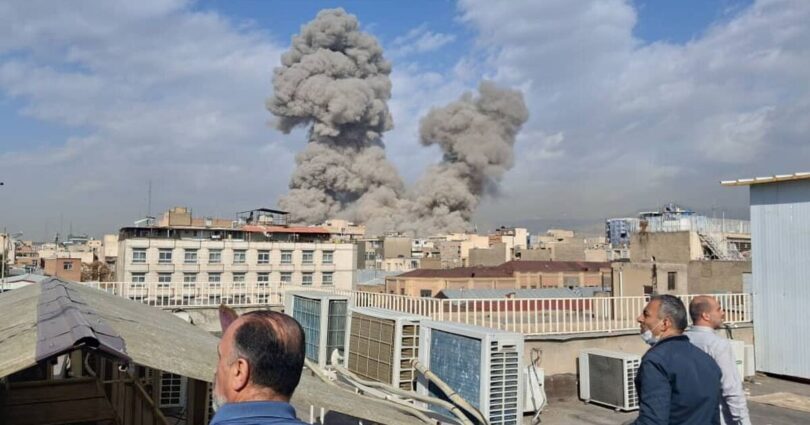
Unlike previous missile exchanges, this is being announced as an all-out war to destroy Iranian-inspired Shia Islamic terrorism, its ballistic missile, naval and nuclear power, and its leadership. Iranian press statements are equally angry because both Trump and Netanyahu have spoken in terms of regime change, and guided by Mossad, targeted senior Iranian officials, including Ayatollah Khamanei, which has not happened before.
However, Iran is not Venezuela. Far more military effort will be required to subdue this potent adversary, which has many covert allies across the Middle East. Any of them could mine the sea lanes, paralysing the movement of oil tankers, conduct sabotage and assassinations. The risk of wider regional conflict and threats to UK interests is very real. US bases in Kuwait, Qatar, Bahrain and UAE have already been hit by Iranian missiles and regional airspace has been closed.
It is difficult to understand what US and Israeli airpower alone can achieve, without boots on the ground. To achieve success may take months, time which might be available to Israel but not to the US, whose combat power is more vulnerable at sea, and needs extensive logistical support.
Equally, President Trump’s invitation to Iranians to “seize control of your destiny” feels too late. His appeal for the fanatics of the Islamic Revolutionary Guard Corps (IRGC) to lay down their arms will be ignored. The most opportune time for US and Israeli intervention was in January during the uprisings across most Iranian cities.
Now attempts to topple the regime will be more difficult. Surgical strikes by American and Israeli aircraft and missiles alone may be insufficient. There will be a balance to strike between removing the Mullahs, IRGC and other leaders, and crushing a wider range of Iranian targets.
Too many attacks, and anti-regime citizens may feel their nation is under attack, rather than their leaders. We are in the early hours of a potentially very serious war, whose end-state is difficult to visualise.
Source link