
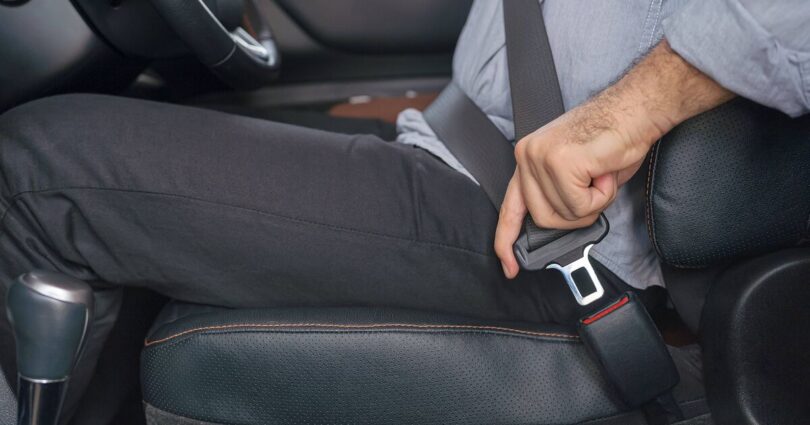
Penalties could be more than just a fine (Image: Kmatta via Getty Images)
With the Government putting forward stricter punishments for motorists who neglect to wear seat belts, fresh research from MoneySuperMarket has revealed that 5.9 million British drivers (14%) admit they routinely drive without fastening their belts.
According to figures from the Parliamentary Advisory Council for Transport Safety (PACTS), in 2023, a quarter of vehicle occupants (25%) who perished in crashes in Great Britain, where seat belt status was recorded, were not wearing one.
In response to this, Alicia Hempsted, car insurance expert at MoneySuperMarket, is urging motorists that, unless exempt or in specific situations, driving without wearing a seat belt is illegal and could lead to a fine of up to £500 under existing legislation.
The fresh survey by MoneySuperMarket discovered that, whilst 7.6 million motorists (18%) admitted they have driven without a seat belt, just over a third (32%) of those have been fined in the past five years for this type of offence. Additionally, 14% (5.9 million) confirmed they regularly drive without a seat belt.
Motorists must always wear a seat belt, unless medically exempt or reversing. If exempt, you must keep your certificate of ‘exemption from compulsory seat belt wearing’ in your vehicle at all times and update your insurer.

At the moment the offence is not endorsable (Image: west via Getty Images)
Read more: ‘1,000 jobs in UK rejected me so I took 2-hour flight and got one easily’
Read more: Key update on 20mph limit expansion across UK as two-thirds ‘not in favour’
Alicia said: « Seat belts are one of the simplest and most effective ways to reduce injury and save lives on the road, so it’s concerning that a significant number of UK drivers admit to not wearing them when behind the wheel. Because insurers use penalty points as a measure of risk, the proposed changes could leave drivers facing more than just a fine. Points on a licence may also push up premiums when it’s time to renew.
« There are a limited number of exceptions to this law, such as when reversing, those who are licensed taxi drivers of a private hire vehicle in specific circumstances, certain delivery drivers, and people who are medically exempt. Should you be medically exempt, you must always keep your certificate in your vehicle, as well as update your insurer of your exemption. For most drivers though, the message is simple: wearing a seat belt isn’t just about avoiding fines, it’s about saving lives. »
UK Government’s proposed seat belt law change
In its consultation proposals, the Government explained: « It has been mandatory since 1991 for drivers and passengers to wear a seat belt when travelling in any motor vehicle unless medically exempt, or under specified circumstances, such as a driver reversing their vehicle or a taxi driver plying for hire. It is also mandatory for drivers to ensure that children under the age of 14 in their vehicle wear a seat belt or are secured with an appropriate child seat or restraint.
« The sanction for failing to do so is a fixed penalty notice of £100 or, if the case goes to court, a maximum fine of £500. Failure to wear a seat belt is not currently an endorsable offence; that means the offender does not incur penalty points. This section asks the public’s view on whether drivers and passengers failing to wear a seat belt, and drivers who fail to ensure children travelling in the vehicle are suitably restrained, should receive three penalty points on their driving licence. »
It added: « We propose that three penalty points should apply to all drivers who fail to wear a seat belt or who fail to ensure that any child in the vehicle wears an appropriate child restraint. »
Current seat belt legislation
Present regulations stipulate that « drivers must wear a seatbelt if one is fitted in the seat they are using, with only a few exceptions. You’re also only allowed one person per seat fitted with a seatbelt ».
Furthermore, « you must make sure that any children in the vehicle you are driving in are in the correct car seat for their height or weight until they reach 135 centimetres tall or their 12th birthday, whichever is first. And ensure they are wearing a seatbelt if they’re 12 or 13 years old, or younger and over 135cm tall ».
Methodology
MoneySuperMarket carried out a poll through Censuswide, questioning 1,000 UK motorists aged 17 and over who hold a full driving licence. The research took place between January 20, 2026 and January 23, 2026. DVLA figures reveal that 42,120,966 individuals currently hold a full UK driving licence.
Ensure our latest headlines always appear at the top of your Google Search by making us a Preferred Source. Click here to activate or add us as your Preferred Source in your Google search settings.
Source link