
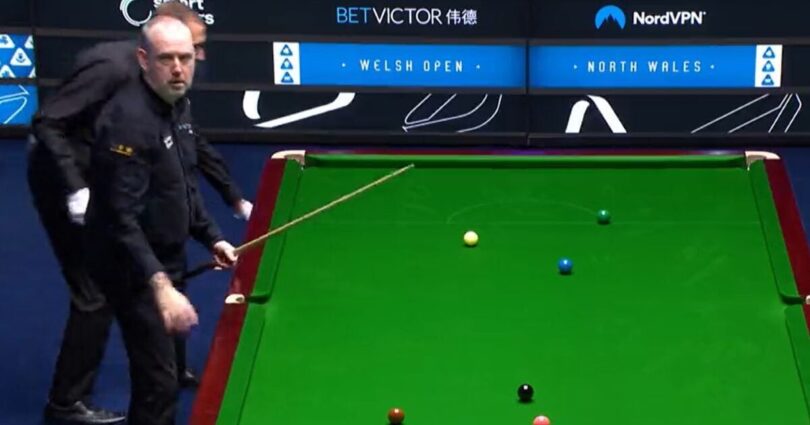
Mark Williams playfully told a snooker official to « shut up » after a rare refereeing error slowed him down at the Welsh Open. Williams, 50, moved into the third round in Llandudno after overcoming Martin O’Donnell 4-1 in their encounter.
It was a routine victory for the Welshman who is bidding to win his first home open since 1999. Against O’Donnell nothing was stopping him from roaring into the next round, such was his efficiency and accuracy. However, there was one moment of confusion which slowed him down in his tracks. In the third frame, Williams potted the final red on the table and then opted to slot in the yellow to bring the score to 51-51.
As he switched his attention to the green, referee Julian Bell headed towards the pocket with the yellow ball in his hand before stopping in his tracks. The confusion was caused by Williams potting the yellow straight after the final red.
Once a colour has been potted, after the final red on the table has been sunk, the colour needs to be placed back on the table, before the player goes through the sequence of clearing the rest of the colours. It’s rare for a player to go for the yellow after the final red, hence the reason there was confusion.
Williams stopped himself and looked at Bell, who was informed by the marker the yellow, which had just been potted, needed to be re-spotted. It was then, Williams playfully told the marker: « Thanks… shut up! »
Ensure our latest sport headlines always appear at the top of your Google Search by making us a Preferred Source. Click here to activate or add us as Preferred Source in your Google search settings
While Williams was speaking in jest, his positioning over the green suggests he played his previous shot to angle up the green, instead of returning to the yellow. However, it was also good he stopped when he did, because playing the green, when he was supposed to go back to the yellow, would have been a foul.
In old snooker rules, the burden of spotting the refereeing error would have fallen on the players, meaning he would have been penalised had he carried on with his break. Nevertheless, modern snooker guidelines state players who continue their break when a referee has not re-spotted the ball would not get penalised.
Rule 7(a) says: « A player shall not be held responsible for any mistake by the referee in failing to spot any ball correctly. » The only way Williams could have been penalised is if he was adjudged to have carried on his break « before the referee was able to complete the spotting ».
The marker’s reminder to the referee not only saved the snooker official from an embarrassing situation, it also provided clarity for the spectators, who may have been used to old snooker rules. Nevertheless, Williams did go on to win the frame to go 3-0 up, before eventually winning 4-1.
Source link