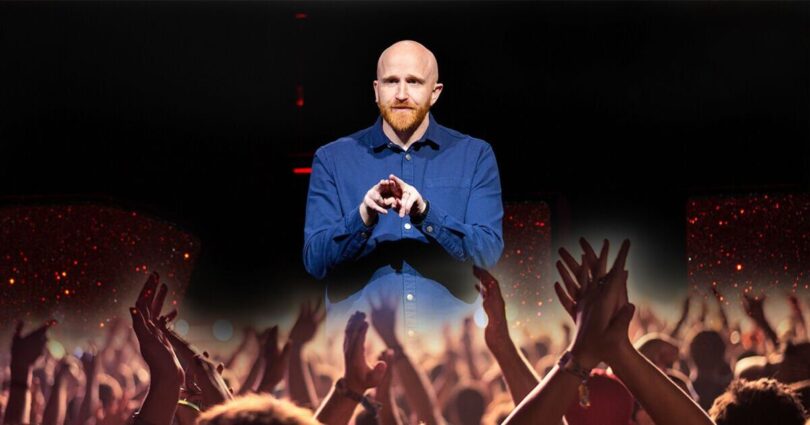
Comedian Ray Bradshaw has a unique story which he brings to his shows (Image: Montage: Ray Bradshaw / Getty)
One in six people in the UK are born deaf or lose their hearing during their lifetime – and two of those are my parents. My dad David, a parks maintenance man, was deaf from birth – he uses sign language – and my mum Jill, a social worker, lost her hearing when she was 14 months old through measles, so she lipreads and talks. This makes me a CODA or child of deaf adults.
When I was younger, I sometimes wished they’d changed it to Youth of Deaf Adults so I could be a YODA. Don’t worry, you can keep reading – that’s definitely the worst joke of the piece so it’s good to get it out the way early! Now 37, I love it when people ask me questions about my upbringing because it’s something I’m hugely proud of.
The standard question is: “What’s it like to grow up with deaf parents?” And the truth is, it’s absolutely brilliant until you run out of toilet roll. Long story short I learnt the sign language for “Dad, I borrowed a sock” at a very early age. When you find yourself that situation, you end up having a lot more responsibilities, though you don’t realise it because it’s all you know.

Ray on stage performing live… he’s kicking off a new show, CODA (Image: Courtesy Ray Bradshaw)
Aged eight, growing up in Glasgow, I would regularly phone the bank for my mum and dad and chat about their mortgage and APR rates. I reckon I was the only under-ten in 1996 who knew what an endowment policy was – which worked out really relatable when I was trying to chat someone up in a nightclub 10 years later sounding like a 40-year-old accountant! It’s these kinds of experiences that I think led me to doing stand-up; from a very early age, according to my friends from school, I was extremely confident and never afraid of public speaking, not to mention quite headstrong.
Throw in a dose of arrogance at the age of 19 and that’s the perfect combination for my first open mic night. Since 2017, I have been doing stand-up shows performed in both British Sign Language (BSL) and English – either by myself doing both at the same time or like on my upcoming tour using a BSL interpreter next to me onstage.
The first tour I did was back in 2018 we had more than 800 deaf people come to their first comedy show which I was hugely proud of until I found out deaf people pay concession prices so my profit was three grand down. A terrible day!
Performing in both languages was a huge challenge but one I loved; my favourite part was seeing people like my family coming to theatres because it’s something we certainly never did growing up. Thankfully, the rise of accessible shows like mine is definitely something that has changed.
My new tour, CODA, focuses on life growing up with deaf parents and how it has shaped the way I think and behave. Growing up with deaf parents puts you in situations that, looking back as an adult and a father, seem nuts. For instance, we went to the deaf social club and there was a deaf Santa two years in a row.
On my first Christmas at primary school, Santa came in and asked me in his big booming voice: “What would you like for Christmas?” I just shouted: “Santa can speak, it’s a miracle!” All the other kids looked at me like I was bonkers. As an adult I saw Miracle on 34th Street, and it turned out he could do both all along.

Ray with his parents, David and Jill, at one of his shows (Image: Courtesy Ray Bradshaw)
I remember finding it odd that my friends couldn’t sign at school when I tried to sign to them in the playground as a youngster. Instead of realising my family was different, I just remember thinking: “These guys are idiots. How am I meant to get toilet roll now?” Slowly but surely, I came to understand that, in my friendship group, we were the odd ones out and it was my parents who were slightly different.
They were always worried about bullying at school because of that, but I was very lucky – nothing like that ever happened. I know that’s not the experience of everyone who has deaf parents which makes me even more thankful. Having my son also made me think a lot more about what it must have been like for my parents to raise three hearing kids in the early 90s – especially without the technology we enjoy these days.
I don’t remember learning sign language so watching my son picking it up is like a flashback moment – except he’s more handsome and not ginger like me!
I watch as I see him interact with his grandparents through things like Facetime and watching YouTube sign language tutorials and I realise it has never been easier to learn the language. I just wish more people in the wider world would do it to make communication better on a wider scale.
The lack of deaf awareness in certain sectors is probably the most frustrating aspect for me. The reliance of family members to be interpreters in health settings is harrowing. My dad recently had quite an important hospital meeting and they either hadn’t booked an interpreter, or they didn’t show up – it’s not quite clear yet – but this is far from a one-off.
I’ve frequently had to step in and interpret in situations that are not the time you want to be relaying vital health info to your parents – trying to translate complex medical terms into sign language where that word doesn’t really exist is a challenge.

Ray as a youngster growing up in Glasgow with deaf parents (Image: Courtesy Ray Bradshaw)
I did a recent poll of fellow CODAs, and the number of people who replied that they had to tell their family members about cancer diagnoses, stroke information and terminal illness information was genuinely horrifying to read. All because family members stepped in at the last minute to interpret, otherwise that crucial appointment would be postponed even longer.
Again, this has got slightly better with remote video call interpreters in Scotland but a lot of the time the health service doesn’t know about it and it is up to the deaf person going through the treatment to raise the issue. This is something that needs to be improved on for the next generation of CODAs.
I guess the reason I’m telling you all this is because I want you to know that growing up with a parent with a disability is not the doom and gloom everyone might think. The number of times I’ve had a pitied response when I tell people my mum and dad are deaf is insane considering I know for a fact I wouldn’t do stand up without the upbringing I had. It made me who I am.
You learn so many skills when you’re young.
Empathy as you learn what to interpret and what not because some idiot has said something that, if interpreted, would hurt their feelings; positivity because you’ve seen two role models who are deaf grow up in a hearing world and thrive because of their mindset and the fact they never gave up despite so many challenges; and most importantly, I think it makes you memorable to other people. It’s a conversation starter, a great first-date ice breaker.
And while you might not have found me funny today, you’ll remember some of the anecdotes or facts. And that’s the legacy every comedian wants!
- Ray Bradshaw is touring CODA all over the UK April 30. Tickets available via raybradshaw.com
Source link