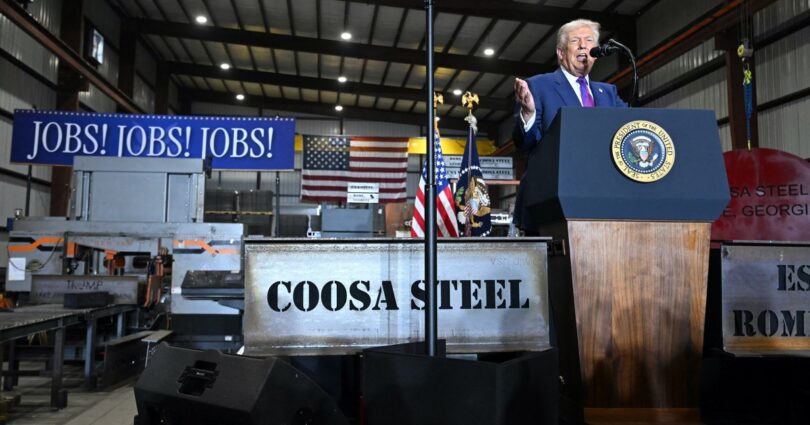
President Donald Trump offered a forceful defense of his tariff agenda Thursday at a steel manufacturing factory in northwest Georgia as the Supreme Court weighs whether to strike down the policy at the center of his economic platform.
The justices could rule as early as Friday on Trump’s authority to impose the kind of broad global tariffs he implemented last year. Losing the case would deal a major economic and political blow to a signature initiative of his second term.
“Thanks to the fact that we got elected on Nov. 5, and thanks to what I call the Trump tariffs, business and steel is booming again,” Trump said after he toured a Coosa Steel Corp. facility in Rome. He also credited tariffs for what he called « a big, massive order » the factory received in October.
At issue in the pending Supreme Court case is whether a law known as the International Emergency Economic Powers Act, which allows the president to regulate imports during times of emergency, grants him the authority to levy global tariffs of unspecified scope and duration. The Constitution assigns Congress the power to set tariffs, and Trump’s challengers in court say he has overstepped his authority.
The Supreme Court heard nearly three hours of oral arguments in November, and the justices gave few clear signals about how they might rule, despite the court’s 6-3 conservative majority.
If the court invalidates the tariffs, the administration could face financial consequences. The government has already distributed $12 billion in tariff revenue to farmers, as it projects nearly $1 billion in tariff revenue next year.
“We’re taking in hundreds of billions of dollars,” Trump said Thursday. “We’re going to be taking in next year $900 million in tariffs, unless the Supreme Court said you can’t do it. Can you believe it? That I have to be up here, trying to justify that?”
The administration is not expected to give up on unilaterally imposing tariffs if it loses the case, but it will need to try to implement them under a different law.
Calling the policy “common sense,” Trump pointed to the $12 billion in economic revenue he said it funded for farmers who were “taken advantage of by many, many foreign nations.”
“Without tariffs, this country would be in so much trouble right now,” he argued.
Trump has increasingly framed tariffs as central not only to economic strength but also to national security and leverage in his quest to settle global conflicts. Earlier Thursday, at an inaugural meeting of his Board of Peace, he credited tariffs with helping defuse tensions between India and Pakistan.
“I said, ‘Listen, I’m not doing trade deals with you two guys if you don’t settle this up.’ … And they do a lot of business with the United States, and they sort of softened up all of a sudden. All of a sudden I read where there was a little bit of a pullback by one and the other; all of a sudden we work out a deal.”

The Trump administration has pushed back against criticisms of the tariff policy, as well as data showing its downsides.
On Wednesday, White House economic adviser Kevin Hassett criticized a New York Federal Reserve finding that U.S. consumers have shouldered much of the burden of the tariffs, calling it “an embarrassment” in an interview with CNBC.
Commerce Secretary Howard Lutnick and Small Business Administrator Kelly Loeffler joined Trump in the Georgia district that until last month was represented in Congress by Marjorie Taylor Greene, a construction business owner and onetime ally of Trump. She had clashed with him over his use of tariffs, among other things, which she said harmed American business owners by increasing costs.
Trump argued that the policy had brought jobs to Rome and other communities. He also promoted his policies to eliminate taxes on tips, overtime and Social Security benefits.
Trump also asserted that he had set record stock market highs since the 2024 election, that Americans’ 401(k) accounts had grown considerably and that inflation had fallen to record levels.
He added that he had “won affordability,” an issue that has come to the fore ahead of the midterm elections this year as voters raise concerns about the cost of living.
“We’ve solved it, and we’re going still lower,” Trump said, adding that he would talk about affordability in next week’s State of the Union address.
Democrats argue that Trump has failed to deliver on his campaign promise to lower costs.
In a statement Thursday, Democratic National Committee Chair Ken Martin called it “another one of Trump’s broken promises.”
“As Donald Trump calls affordability a ‘fake word’ and ‘hoax’ and spends his time building gilded ballrooms, Georgia families are seeing costs rise, health care get more expensive, and jobs disappear,” Martin said.
“While Donald Trump and Georgia Republicans continue to make life more expensive for hardworking families, Democrats in Georgia and across the country won’t stop fighting to lower costs and protect health care.”
Source link