
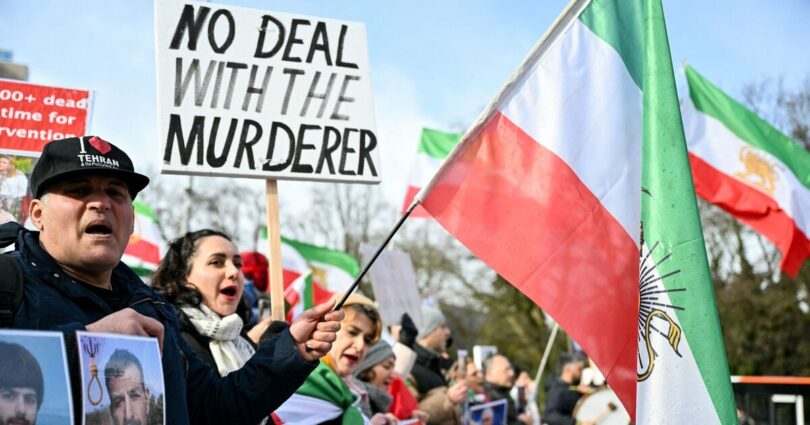
Anti-Ayatollah protesters (Image: Getty)
Periods of political strain invariably produce contending claimants to leadership. Iran today is living through such a moment. Economic hardship, continuing unrest and an embattled regime have made political change less conjectural than it once seemed. That, in turn, has encouraged a familiar phenomenon: aspiring leaders try to turn visibility into authority, hoping that attention abroad will be mistaken for legitimacy at home. In such circumstances, it is worth stating a simple rule. Credibility is cumulative. It is earned through evidence, organisation and discipline, not through slogans, staged moments or statistics that collapse under scrutiny. The standard is a demanding one, precisely because the stakes are so high.
A recent episode in Munich offered an instructive case study. On the margins of the city’s Security Conference, a rally was promoted by supporters of Reza Pahlavi, the son of the deposed Shah, as proof of a surging public mandate. Within hours, sympathetic networks were circulating an attendance figure attributed to the Munich Police: 250,000 people. The number travelled rapidly across social media and was presented as though it settled a political argument.
It did not. Almost immediately, responsible analysts and local observers examined the claims in the way one would expect. They looked at overhead images, the footprint of the site, transit flow, and the practical constraints that govern large gatherings in a European city.
Their conclusions converged on a far lower range, in the tens of thousands. Even the most generous assessments fell well short of six figures. Residents familiar with the area made a basic point: gatherings approaching a quarter of a million would inevitably be felt well beyond the immediate location, through overwhelmed public transport, traffic paralysis and visible overflow into surrounding districts. Munich did not display those effects at the scale such a crowd would generate.
Of course, the precise number is not the point. A rally of tens of thousands is not trivial. But leadership is not conferred by arithmetic, and credibility is not achieved by insisting on a claimed level of support that strains belief. If a political camp is willing to promote an implausible claim, it invites a wider question: what else is being asserted without a firm foundation? That question is damaging because it is avoidable. Serious movements do not need embellishment. They demonstrate strength through organisation and consistency, not through headline numbers that cannot withstand daylight.
This matters for reasons beyond the immediate issue. Opposition politics depends on trust. International observers, journalists and policymakers may be sympathetic to democratic change in Iran, but they need reliable interlocutors. When claims are inflated, scepticism is the natural consequence. And scepticism, once aroused, is difficult to reverse.
The Munich episode also drew attention to a second, deeper issue: the gap between visibility abroad and practical capacity inside Iran. In media appearances during the same period, including a town hall discussion with journalist Christiane Amanpour, Pahlavi faced questions about political programme, past statements, and the mechanics of change. Viewers were not looking for theatre. They were looking for structure.
Some of the questions put to him were straightforward. What organisational framework exists to translate rhetoric into coordinated action? What domestic network can sustain momentum under pressure? How, in practical terms, does a transition occur?
Pahlavi was also challenged about earlier claims that tens of thousands of security personnel had defected to his side, an assertion for which no evidence has materialised. Such claims, like inflated crowd figures, create a credibility problem when they cannot be substantiated, especially when events inside Iran have shown the regime’s coercive apparatus still functioning during moments of acute protest.
Equally significant was what surfaced when the discussion turned to power and legitimacy. When pressed on how change would be achieved, the emphasis appeared, at points, to drift towards external intervention rather than internal mobilisation. That is a warning sign, not because foreign governments have no role at all, but because durable political legitimacy cannot be imported. International support can assist a people seeking freedom, but it cannot substitute for internal cohesion, domestic networks and a leadership capable of organising sustained action under threat.
There was also the question of discipline. Some of Pahlavi’s most vocal supporters online have targeted critics and activists with intimidation. That is not a minor matter. In politics, the capacity to set boundaries, restrain excess and impose basic standards on one’s own camp is a measure of authority. General sentiments are not the same as clear instruction. If a would-be leader cannot or will not impose firm conduct boundaries on his own supporters, he is unlikely to command confidence among those who know that a transition, if it comes, will be difficult and morally demanding.
All of this points to a wider lesson. Movements that achieve change tend to display consistent characteristics: internal leadership structures, coordinated strategy, resilience under repression and credible lines of accountability. They are rarely the product of a single personality, however prominent, elevated by publicity abroad. They endure because they are organised, and because their legitimacy is rooted in sustained effort, not in episodic spectacle.
For those trying to understand Iran’s political landscape, it is therefore sensible to ask a different question from the one that dominates social media. Instead of, “Who drew the biggest crowd in Europe?”, the question should be, “Who has demonstrated the capacity to organise, withstand pressure and command trust inside Iran?” That is where credibility is made or broken.
It is also important to be candid about a point too often obscured by the focus on diaspora personalities. Organisation within Iran exists. It is not theoretical. It is the presence of internal networks, built over time and sustained at significant personal cost, that gives an opposition movement weight. Those who operate in that environment are not inclined to inflate numbers for effect. Their credibility is tested by surveillance, imprisonment and the brutal realities of day to day resistance. That is why organisation matters more than optics. It is also why international audiences should be wary of substituting stage-managed demonstrations abroad for the difficult, grinding work of building a credible movement at home.
None of this is to deny that Iranians in the diaspora care profoundly about their country’s future, or that public demonstrations abroad can play a part in raising awareness. Leadership, however, must be judged on a clear and exacting standard. Media publicity is not a plan. A crowd, however large, is not a governing programme. A disputed statistic is not legitimacy.
Those who aspire to lead a post-theocratic Iran must persuade sceptics not with slogans or inflated figures, but with evidence of organisation, discipline and accountability.
The future of Iran will not be decided by media metrics in European cities. It will be shaped by realities on the ground within the country: the strength of internal networks, the coherence of strategy, and the capacity to sustain pressure while retaining moral authority. Anyone seeking to lead that future must meet that test. Numbers alone do not confer credibility. They never have.
The Rt Hon David Jones was former president of the British Committee for Iran Freedom. He served as Welsh Secretary under David Cameron and Minister of State at the Department for Exiting the European Union under Theresa May. In 2025 he joined Reform UK.
Source link