
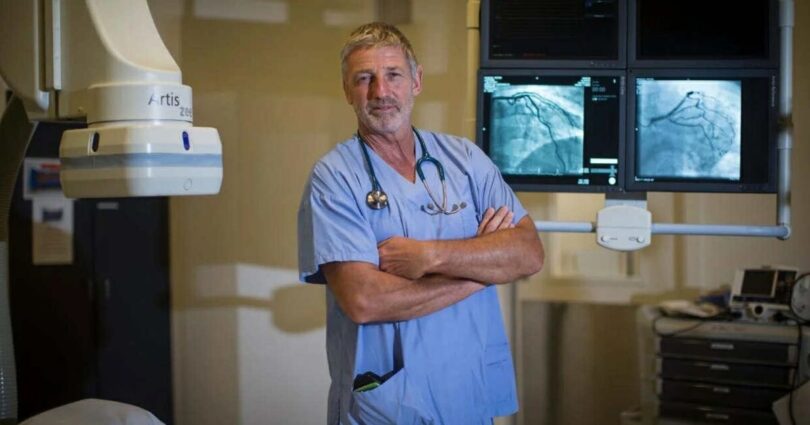
Liam Hughes’ new book, Bodily Fluids, sets out a lifesaving prescription for the NHS (Image: Courtesy Liam Hughes)
After starting in the 50s, the BBC drama Call the Midwife has now reached the 70s, the decade when my career started. In the years leading up to my retirement two years ago, some younger colleagues affectionately called me a dinosaur with rose-tinted spectacles whenever I lamented the passing of the old regime.
But given the relentless rise in dissatisfaction among patients, their relatives and health providers, revisiting previous models of care and training can highlight a way forward for the failing NHS. Morale is dangerously low and the NHS has been stripped of its once-universal esprit de corps. The potential causes are many and there is no quick fix, but without surgery our once-favourite institution will flatline.
Read more: Scientists make bombshell claim about what happens after we die
Read more: The foods men and women should eat to add years to their lives — full list
Rebuilding the esprit de corps
The medical workforce is less united than ever before. GPs and hospital doctors have little contact, with both groups blaming each other when things go wrong. The same is true for the relationship between residents and consultants. In my first year, I had one particularly busy weekend on call. I clerked the admission of 53 patients, all of whom had a GP letter or had been discussed with me or my consultant.
The Monday morning round took until the evening, after which we were treated to beer and a curry by the boss. I still remember some of the cases and learned more in a few days than months as a student. I presented hundreds of patients to the team and received priceless feedback on all my decisions. This sense of support gave me confidence.
Today, based on my conversations with younger colleagues, it’s clear that first-year medics have a totally different experience. Working an average of four 11.5-hour shifts each week, few work for a specific consultant and they often spend shifts in different departments. Many remain unaware of what happened to patients they assessed, and none reported the dopamine buzz of being given thanks by recovered patients.
One told me that all patients admitted to their ward had been designated not for resuscitation. No one I spoke to had been for an off-duty meal or drink with any co-workers and certainly not a consultant, and many reported feeling isolated and unsupported.
Patients need ‘proprietorial’ care
This cannot happen without regular master-and-pupil feedback on thousands of cases which current resident doctors are missing out on. While I found it hard as a student to remember the branches of the brachial plexus or the stages of the Krebs cycle, recalling the histories and test results of patients came easily to me.
It’s a facility I never lost. This is because that information had real consequence and, ingrained by my early bosses, it emphasised the importance of taking proprietorial responsibility for patients under your care. This rarely happens in 2026. Rather, patients are often under a department with consultants running a rota, sometimes changing daily. Doctors also rotate, so continuity is lost. This is dangerous for patients and a disaster for training.

Shift work in hospitals radically increases the number of tests and investigations patients undergo (Image: Getty)
Shift work causes unnecessary investigations
Working in shifts increases the number of investigations patients undergo. This mainly applies to acute admissions. Doctors will only have a 50% chance of seeing the patient again. Arranging an imaging test, for example, delays the need to instigate treatment. That decision can be deferred to the following team without the risk of being accused of leaping in with a particular treatment. At senior level, ego will sometimes also cause one consultant to arrange esoteric tests to impress the handover team. Few will believe this happens, but most senior doctors know it to be true.
We need ‘firms’, not shifts
Restoring a “firm” rather than a “shift” model of care would benefit all but making the change will be nigh-on impossible. The tiredness argument will be raised and the known documented risks of constant patient handovers will be dismissed. Looking after patients over a 24-hour period can be safe if there are short breaks. It is more akin to sailing solo in the Southern Ocean than driving a petrol tanker down a motorway (the most often-quoted example in the argument against long hours).
The latter requires absolute unbroken concentration without distraction; the former, as round-the-world sailor Alex Thomson has explained, requires short periods of rest as and when possible, coupled with laser-like focus when on deck.
A “firm” system would also make an individual consultant responsible for each patient. Senior cover should rotate weekly not daily, so patients and their relatives have continuity. Patients previously admitted under one consultant should be handed back if readmitted. Each day the consultant could see the new admissions with the overnight first-year doctor by conducting a 6am round which allows the resident to go off duty on time.
First year doctors should look after individual patients:Allowing first-year doctors to look after patients in such a rota with the appropriate support from an on-site middle grade and consultant available for calls would enhance their experience. Doctors in acute specialities should not be working in shifts. This isn’t simply better care but politically essential. Once doctors became just another shift-based provider of care, they lost political power and governments have exploited this.
My advice to anyone admitted would be to ask the name and contact details of the consultant who will oversee their care and the times when the admitting resident doctor will be on duty. I would also add the name of the senior nurse overseeing my care. These are not unreasonable requests, but many NHS inpatients won’t know who oversees their care.

Hughes as a young NHS doctor nearer the beginning of his long career (Image: Courtesy Liam Hughes)
Man the barricades
Hospital beds are a scarce resource. Currently, they are offered to many people who don’t require one and others who would be better cared for elsewhere.
The shameful underfunding of primary care has resulted in patients who are desperate to see a doctor, turning to their local hospital. The GP service will take years to repair but, in the meantime, hospitals should redeploy their staff to meet this huge influx. A study I conducted 10 years ago might offer a way to reduce admissions. Senior doctors in charge of front door areas are incredibly experienced, but they are generalists with good understanding of a very wide range of conditions.
To aid their decision making, especially regarding whether the patient needs to be admitted, numerous protocols have been developed. The guidelines regarding some symptoms are risk-averse, which results in many admissions that turn out to be unnecessary after later review by a specialist.
One such symptom is chest pain. Most people are not at immediate risk, but both the sufferer and doctor worry as chest pain can indicate a life-threatening cause in a small percentage of cases. Proving that someone’s chest pain doesn’t have a life-threatening cause is far more complicated than detecting those who do have one. When I reviewed this cohort of patients, around 70% did not require admission.
We all know the frustration caused by the time it takes from attending A&E to getting a decision. Deploying the on-call consultant for every speciality would streamline treatment and the critical decision about whether to admit or not. Even those whose admission depends on a test result would benefit as the system would not be overwhelmed by the over-investigation of low-risk patients by less experienced staff.
- Liam Hughes spent nearly five decades on the NHS frontline, ultimately as a senior cardiologist before retiring two years ago. His new book, Bodily Fluids, lays out a radical new prescription to save the NHS

Bodily Fluids by Liam Hughes recounts the author’s five-decade NHS career (Image: Eye Books)
Source link