
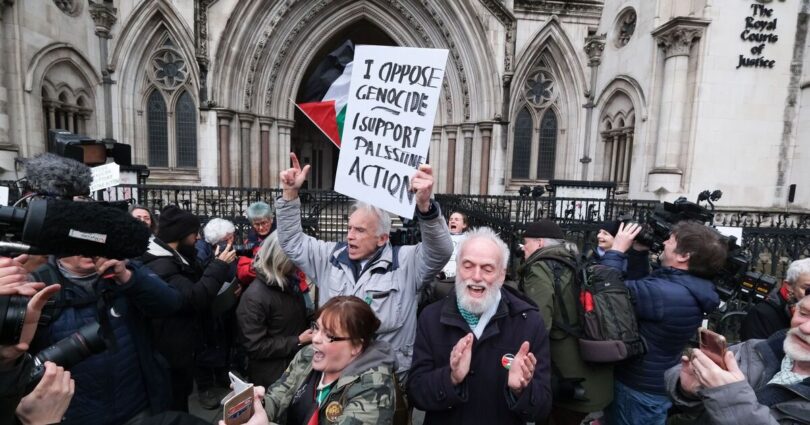
People expressing support for Palestine Action will not be arrested (Image: Getty)
People expressing support for Palestine Action will not be arrested following the bombshell High Court ruling, Scotland Yard said.
Judges ruled the group “organised and undertaken actions amounting to terrorism” but should not be put on a par with ISIS and Al-Qaeda.
Palestine Action won a legal challenge against the Home Office’s decision to proscribe it as a terrorist organisation despite widespread concern over its criminal activity.
But the ban will be extended until further legal submissions are made, meaning expressing support for the group is still a criminal offence.
And the Metropolitan Police revealed they are pausing arrests because of the « unusual circumstances ».
Officers said: “We recognise these are unusual circumstances and there will likely be some confusion among the public as to what happens next.
“From a Metropolitan Police perspective, officers will continue to identify offences where support for Palestine Action is being expressed, but they will focus on gathering evidence of those offences and the people involved to provide opportunities for enforcement at a later date, rather than making arrests at the time.
“This is the most proportionate approach we can take, acknowledging the decision reached by the court while recognising that proceedings are not yet fully concluded.
“This approach relates solely to the expression of support for Palestine Action.
“We will continue to intervene and make arrests where we see people crossing the line from lawful protest to intimidate, to damage property, to use violence, to stir up racial hatred or to commit other offences.”
Home Secretary Shabana Mahmood declared she is “disappointed” by the High Court ruling, adding the Home Office will appeal it.
The decision means that more than 2,000 people who were arrested for holding signs or displaying messages in support of the group may now have proceedings dropped.
Dame Victoria Sharp, sitting with Mr Justice Swift and Mrs Justice Steyn, said: “Deciding where the balance should be struck in this case is difficult.
“When striking the balance between issues such as these the court must permit some latitude to the Home Secretary given that she has both political and practical responsibility to secure public safety.
“Nevertheless, we are satisfied that the decision to proscribe Palestine Action was disproportionate.
“At its core, Palestine Action is an organisation that promotes its political cause through criminality and encouragement of criminality. A very small number of its actions have amounted to terrorist action.”
But the Home Secretary vowed to fight on.
Ms Mahmood said: “The Court has acknowledged that Palestine Action has carried out acts of terrorism, celebrated those who have taken part in those acts and promoted the use of violence.
“It has also concluded that Palestine Action is not an ordinary protest or civil disobedience group, and that its actions are not consistent with democratic values and the rule of law.
“For those reasons, I am disappointed by the Court’s decision and disagree with the notion that banning this terrorist organisation is disproportionate.
“The proscription of Palestine Action followed a rigorous and evidence-based decision-making process, endorsed by Parliament. The proscription does not prevent peaceful protest in support of the Palestinian cause, another point on which the Court agrees.
“As a former Lord Chancellor, I have the deepest respect for our judiciary. Home Secretaries must however retain the ability to take action to protect our national security and keep the public safe. I intend to fight this judgment in the Court of Appeal.”
Around 100 people gathered outside the High Court in central London, cheering and chanting “Free Palestine” after judges ruled that the Home Office’s decision to ban Palestine Action under terrorism laws was unlawful.
Waving Palestinian flags, many of the activists are holding placards in support; one reads: “I oppose genocide, I support Palestine Action.”
Huda Ammori, who brought the legal action, said: “Palestine Action is the first civil disobedience organisation that does not advocate for violence to be proscribed by the British government as a ‘terrorist’ group, in a Trumpian abuse of power which would have seen this Labour government proscribe the suffragettes.
“This ban was unlawful, resulting in the unlawful arrest of nearly 3,000 people – among them priests, vicars, former magistrates and retired doctors – under terrorism laws for simply sitting in silence while holding signs reading: ‘I oppose genocide – I support Palestine Action’.”
Dame Victoria said Ms Ammori had won on two of her four grounds of challenge, but said the ban would remain to allow further arguments and the Government time submit an appeal.
That means it currently remains a criminal offence to be a member of, or support, Palestine Action.
She said lawyers for Ms Ammori and the Home Office had until February 20 to provide written submissions on “the terms of the order that should be made”.
In their ruling the judges said: “Real weight must attach to the fact that Palestine Action has organised and undertaken actions amounting to terrorism.
“It is significant that Palestine Action has not suggested that its actions that have been assessed to comprise terrorism were either a mistake or an aberration.
“Rather, Palestine Action has lauded those who took part in those actions.
“It is, further, significant that the contents of the Underground Manual provide good evidence of Palestine Action’s continuing intention to promote the use of violence regardless of the risk that this will result in serious damage to property or serious violence against members of the public.”
And the judges said it is not « sustainable » to describe Palestine Action as « non-violent ».
They concluded: « The claimant in her case in these proceedings has sought to portray Palestine Action as a “non-violent” organisation.
« This is not a sustainable proposition. It rests on the premise that damage to property, regardless of extent, does not involve the use of violence.
« That is a view that many would struggle to comprehend, and we for our part are unable to accept, especially when such damage goes further than the merely symbolic.
« The proposition also ignores the real risk of injury (to members of the public) which may occur when individuals go equipped with sledgehammers to do damage to property as Palestine Action suggests they should do, and are intent at the same time on avoiding detection. »
Source link