
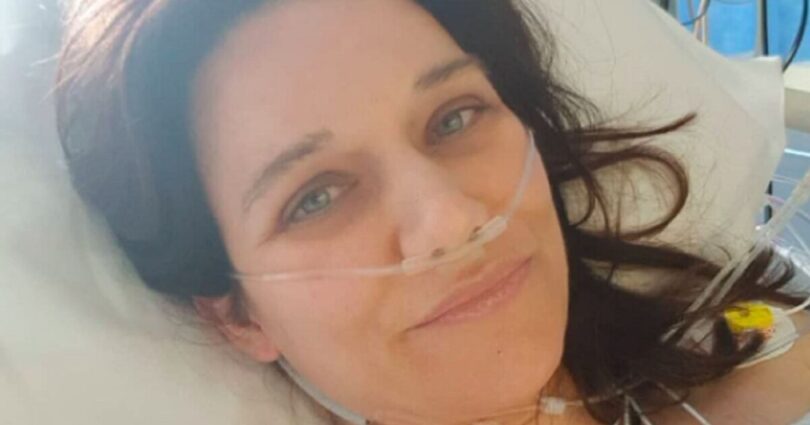
Kerie Ivory is battling neuroendocrine cancer (Image: Kerie Ivory)
Locked in a 14-year battle with a rare cancer, a mother-of-two is enduring a nervous wait for her tumours to grow larger so she can be treated. The NHS goal for patients who are suspected of having cancer is for them to be referred to a specialist within two weeks, with common treatments including surgery, immunotherapy, chemotherapy, and radiotherapy.
But patients like Kerie Ivory, who has neuroendocrine cancer, first face a battle to be diagnosed, as many GPs have never heard of the disease. And then after diagnosis, they face a lengthy wait for treatment, as a lot of the usual treatments, like chemotherapy, are not very effective with slow-growing neuroendocrine tumours.
READ MORE: ‘Changes must happen so all cancer patients have an equal chance of survival’
READ MORE: ‘I received devastating diagnosis aged just 36 — NHS badly needs change’
Ms Ivory, from Buckinghamshire, said: “It’s hard living with a slow-growing, creeping cancer – I am constantly waiting for the tumours to grow big enough to get treatment that is appropriate for me.
“It’s devastating knowing I have cancer and we are not treating it. A lot of other cancers have the kitchen sink of treatments thrown at them. I’m forced to live with this disease rather than eradicate it.”
The 52-year-old has had surgery to remove a tumour in her bowel and surgery to remove tumours in her liver, but says the tumours she has now cannot be removed. Instead, she has to wait.
She said: “It’s difficult on a lot of levels. I get asked all the time, ‘Oh, have you had chemotherapy?’ And I haven’t because it doesn’t work for most neuroendocrine cancers.
“And then I think people’s assumption then is that it’s not as serious because you haven’t had to have chemotherapy.
“Now that I am living with it, I think I find the lack of sort of treatment options harder. When I had it in the first instance, and I had the surgery to remove it, life got back to normal.
“And then when I had my first recurrence in my liver, and I had surgery to remove that, life got back to normal.
“But then, when it came back again, and they couldn’t remove it, that’s when my health took a real downturn. »

Kerie Ivory pictured two months after her first surgery (Image: Kerie Ivory)
Ms Ivory said: “My cancer is slow-growing, and I can’t have surgery to remove one of the tumours in my liver now because they’re in a difficult place in between the major blood vessels.
“The treatments that are available are limited, and so they would rather wait until you have a high burden of disease so that they can be most useful. You don’t want to use all your options too early, to then not have anything when the disease progresses.”
She was diagnosed with neuroendocrine cancer back in 2012, after an ultrasound revealed an enlarged lymph node in her stomach near her belly button.
But she was only sent for the ultrasound after 15 months of appointments with GPs, where they could not work out what was wrong.
Her first few symptoms were what she describes as “niggly complaints”, including a cough which was initially thought to be a symptom of asthma, and then considered to be due to a nasal drip. And then she was started on reflux medication as it was thought to be reflux.
When her symptoms worsened, she got increasingly frustrated as she was feeling unwell all the time, but no one could say why. Symptoms then included severe fatigue, anaemia, bowel issues, stomach pains and being bloated every day, and her stomach being full of gas.
The mother-of-two says the recently introduced Jess’s Rule, which encourages doctors to rethink a patient’s care if they visit three times with the same or worsening symptoms without a precise diagnosis, would have helped her.
But she says the danger with neuroendocrine cancer is that the symptoms can change, so she wasn’t necessarily going back to her GP with the same symptom each time.
She said: “The incidence of neuroendocrine cancer is going up, so GPs are going to be seeing more people with neuroendocrine cancer. So, definitely something has to be done, because otherwise, more people won’t get an early diagnosis.
“And I just want people to be different for the people that come after me. That’s the point of sharing my story.
“Things do change. I don’t know if I had got a diagnosis earlier, if I was diagnosed stage three and it already spread to my lymph nodes, but, you know, maybe if I’d been diagnosed at an earlier stage, I wouldn’t have stage four cancer now.”
What is neuroendocrine cancer?
Neuroendocrine cancer is a type of cancer that begins in the neuroendocrine cells, which are found throughout the body. These cells can release hormones that regulate many body functions. When they become cancerous, they can grow in almost any organ.
Neuroendocrine cancer can start anywhere in the body, and symptoms can vary greatly between people, which makes it hard to detect. Most neuroendocrine cancers tend to be slow-growing, but some forms can be aggressive and grow rapidly.
The most common neuroendocrine cancers tend to originate from the gastrointestinal tract, pancreas or lung.
Most neuroendocrine cancers occur sporadically. This means that there is no known genetic link to how or why they have developed. However, there are a number of rare inherited genetic conditions that may increase someone’s risk of developing a neuroendocrine cancer.
Source link