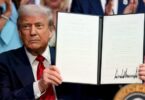

President Donald Trump plans to nominate Kevin Warsh to the board of the Federal Reserve as a governor and the next chair of the central bank.
If confirmed by the Senate, Warsh would succeed Jerome Powell, whose tenure as chair ends in May.
Trump announced the nomination in a post on social media Friday morning.
« I have known Kevin for a long period of time, and have no doubt that he will go down as one of the GREAT Fed Chairmen, maybe the best, » Trump wrote.
« On top of everything else, he is ‘central casting,’ and he will never let you down, » the president said.
Trump did not mention Powell in the announcement. But Warsh’s Senate confirmation process will likely be made much more difficult as a result of the pressure campaign Trump has waged against Powell and the bank to drastically lower interest rates.
That campaign has alienated key senators whose support Warsh will need in order to be confirmed by the closely divided Senate.
Trump met with Warsh Thursday in the Oval Office and offered him the Fed chair job, a senior administration official told NBC News.
Warsh, 55, already has years of experience serving at the central bank.
From February 2006 until March 2011, he served as a Governor on the Fed’s board, nominated to the role by then-president George W. Bush.
During his time on the Fed’s board Warsh also gained international relations experience as the central bank’s representative to the G-20, which as Fed chair could be useful.
The Fed deals frequently with the likes of the European Central Bank, Bank of Japan, Bank of England and other critical central banks on matters such as global economic stability or at times of economic turmoil.
By serving as a Fed governor during the 2008 crisis, Warsh also gained experience in the depths of one of the worst financial crises in history.
Warsh also oversaw some of the Fed’s administrative duties during his tenure, looking after its operations, personnel and financial performance. Before joining the Fed, Warsh worked at Morgan Stanley in mergers and acquisitions and as advisor to companies in critical sectors such as the manufacturing and tech sectors.
“I hope that my prior experience on Wall Street, particularly my nearly seven years at Morgan Stanley, would prove beneficial to the deliberations and communications of the Federal Reserve,” Warsh said in his 2006 confirmation hearing.
The position of Federal Reserve chair is among the most important economic roles in the world. Other central banks, policymakers and businesses around the globe turn to America’s independent Fed to help pilot the global economy through good times and bad.
It is also one of the most consequential hiring decisions a U.S. president gets to make, second only to lifetime appointments for federal judges. Members of the Fed’s seven-person board of governors serve 14-year terms, offering presidents the chance to shape monetary policy long after they leave office.
Warsh was selected from a short list that had included BlackRock fixed income executive Rick Rieder, current Fed governor Christopher Waller and current National Economic Council director Kevin Hassett.
Trump nominated Powell to chair the Fed during his first term. Trump’s successor, Democratic President Joe Biden, renominated him to another four-year term.
The Fed sets a key interest rate that affects consumer borrowing costs, and it supervises major banks for the world’s largest economy. It also regulates the supply of U.S. dollars, the world’s dominant reserve currency.
For most of its existence, the Fed has operated largely free from interference or pressure from the White House. In the U.S. and around the world, independent central banks are seen as key elements of maintaining stable financial systems.
Trump, however, has rejected that model. Instead, ever since his first term in office, he has looked for new and increasingly heavy-handed ways to pressure Fed governors to vote for lower interest rates, which he believes will fuel the U.S. economy.
Expectations that Trump would tap Warsh caused stock futures to fall overnight, although they were off their worst levels around 7 a.m. ET., when Trump made the formal announcement.
U.S. government bond yields rose for 10-year and 30-year Treasuries, a potential sign of concern among investors over the central bank’s keeping a lid on inflation.
For most of his public career, Warsh has been considered a « hawk » on monetary policy, meaning he was generally in favor of higher interest rates, focused more on keeping inflation in check than on making money cheaper to fuel economic activity. Since emerging as a possible successor for Powell, however, Warsh has changed his tune.
The Fed’s « hesitancy to cut rates, I think, is actually … quite a mark against them, » Warsh said on CNBC in July, criticizing the current slate of Fed policymakers.
Political pressure cooker
From constantly badgering Powell for lower rates to accusing him of mismanaging renovations at the Fed’s Washington headquarters and, most recently, standing by while his Justice Department launched a criminal investigation of Powell and the Fed, Trump has been unrelenting in his campaign to undermine the bank and its chair.
That campaign may ultimately make it much more difficult for Trump’s nominee to win Senate confirmation and take up the post.
The criminal investigation, which Powell announced this month, shocked and infuriated senators, both Republican and Democratic. One senator whose vote will be crucial to advancing Warsh, Republican Thom Tillis of North Carolina, has already said he will block any nominee until the Justice Department resolves its investigation of Powell and the bank.
That bitter, deeply distrustful environment is what awaits Warsh as he prepares to begin a lengthy confirmation process.
Trump is also the first president to try to fire a sitting Fed governor. That official, Lisa Cook, is fighting his effort in a legal case that has reached the Supreme Court after lower courts kept her in place.
After oral arguments in the case Jan. 21, the court is expected to rule on Cook’s fate — and possibly broader questions of presidential power over independent agencies — in the coming months.
A climate of uncertainty
Trump’s Fed nomination comes at a fraught moment for the U.S. economy.
The U.S. labor market has been slowing since the summer, and recent data has not indicated a significant pickup in hiring. At the same time, inflation has not returned to its April rate of 2.3% year-over-year. After having climbed every month from April to September, inflation settled at 2.7% in December, still well north of the Fed’s 2% target rate.
Trump’s mercurial style of decision-making and his tariff agenda have shaken global markets and tested America’s trade relationships.
In addition to the labor market and inflation, the view from abroad of the U.S. as a stable place to invest has changed since Trump took office.
Last year, the U.S. dollar index, which measures the strength of the dollar against other currencies, tumbled 9%, for its worst year since 2017. That makes it more expensive for Americans to travel abroad and import goods from overseas.
Trump has also placed sweeping import duties on nearly every one of America’s trade partners. Since the fall, however, the administration has started to water some of them down as an affordability crisis has turned into a political liability for Republicans in November’s midterm elections.
The Supreme Court is set to rule on whether Trump had the authority under an emergency economic law to bypass Congress and enact his country-specific tariffs last year. The outcome of that case could change the trajectory of inflation, consumer spending and global trade.
Source link