
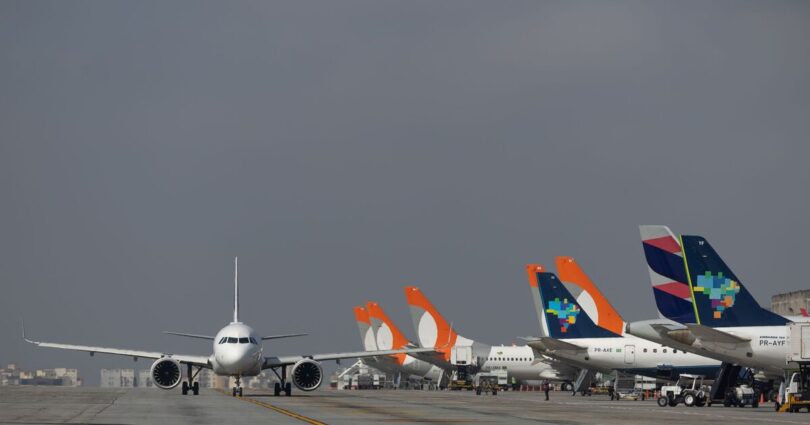
Global aviation is growing rapidly (Image: Getty)
Huge airport projects are underway across the globe that will transform how and how often we travel.
By some metrics, the 2020s are the decade of flight. Although the golden era of aviation – when Concorde flew, planes were carpeted and smoking at 30,000 was inexplicably a normal thing to do – is long behind us, now is the moment of mass air transport.
Each year, more planes are flying to more destinations, carrying more people than ever before. Aviation has grown rapidly in scale, capacity, and geographic coverage, and it doesn’t seem to be slowing down anytime soon.
The numbers are clear. More than 90 million passengers travelled through UK airports between July and September last year alone, making it the busiest summer ever recorded, according to the UK Civil Aviation Authority. Over the whole year, that figure likely hit 300 million.
Globally, air travel was expected to reach a whopping 9.8 billion passengers in 2025, a 3.7 per cent year-on-year increase, according to the Airports Council International (ACI). Meanwhile, the global passenger count for 2026 is anticipated to shoot up 400 million to hit 10.2 billion.
To keep up with demand, 3,593 new routes were launched across multiple airlines in 2024 and 2025, according to ACC Aviation. And more is to come. It’s predicted that the global commercial fleet will double by 2043, adding more than 23,000 new aircraft.
From a climate perspective, this rapid expansion is a huge worry. By 2020, aviation emissions were 70% higher than in 2005 and they could grow by 300% by 2050. In 2018, global commercial operations generated 2.4% of all CO2 emissions, according to the IPCC. That figure, which doesn’t even take more damaging emissions such as Nitrous Oxide into account, will shoot up in the coming years as the global middle class grows.
To deal with the increased demand, countries across the world are embarking on huge airport building projects. Below are just a handful of some of the biggest to come.

A new four-runway airport is being built in Ethiopia that’s expected to have the (Image: Ethiopian Airlines)
Poland
One mega hub is the proposed $32.5 billion project for the Centralny Port Komunikacyjny (CPK) in Warsaw, Poland, which is set to rival London’s Heathrow and Dubai International. Designed to become Warsaw’s cutting-edge aviation hub, it could cater for up to 34 million travellers every year, with ambitions to ramp that figure up to 44 million. (Heathrow currently handles 84 million)
The massive airport will house approximately 140 check-in desks, with the capacity to expand to 170 as traveller volumes increase. The terminal will feature over 20 dedicated contact stands suitable for both narrow-body and wide-body aircraft, with phased expansion planned.
There are also bold plans to merge air travel with high-speed rail services, as it’s set to incorporate an underground railway station forming part of the Warsaw High-Speed Rail Line. The rail network is due for completion by 2029, though the airport itself isn’t expected to be fully operational until 2032.
Ethiopia
Work is already underway at Bishoftu International Airport, which is set to become Africa’s biggest new airport and cater for up to 110 million passengers annually. The £9.3 billion mega-hub near Bishoftu will feature four runways and accommodate up to 270 aircraft.
The airport is being designed as a fully-integrated « Airport City » in Africa, featuring cargo hubs, hotels, commercial zones, logistics parks, and maintenance facilities. Among the improvement plans is a high-speed railway connection and a multi-lane highway in the capital.
Originally designed to launch in stages, the initial phase will handle 60 million passengers per year, with subsequent expansion stages boosting capacity to 110 million. The hub, anticipated to be fully operational by 2030, is set to become Africa’s most ambitious aviation infrastructure project.

Dubai is moving its main airport operations to Al Maktoum International (Image: Getty)
United Arab Emirates
Dubai International Airport, the globe’s busiest hub for international passengers, is set to relocate. As part of a mammoth £28 billion scheme, the airport will move its entire operation to the emirate’s second airport, Al Maktoum International Airport at Dubai World Central (DWC), in the southern desert.
The cutting-edge complex will feature white terminals inspired by traditional Bedouin tents, five parallel runways and an impressive 400 aircraft gates. The DWC welcomes more than a million passengers each year, but the new hub will have an annual capacity of 150 million. The major move is expected to get underway « within the next 10 years », with Dubai Airports CEO Paul Griffiths sharing that it should take place in 2032.
Saudi Arabia
King Salman International Airport is currently under construction to replace King Khalid International Airport. When it opens in 2030, it’ll have three runways and be one of the biggest in the world. The airport will eventually include six passenger terminals and six runways, covering an area of 57 km2. It is designed to handle 100 million passengers per year by 2030, and 185 million passengers per year by 2050. Currently,
Hartsfield–Jackson Atlanta International Airport in the US is the busiest airport in the world, handling over 108 million passengers in 2024.
Source link