
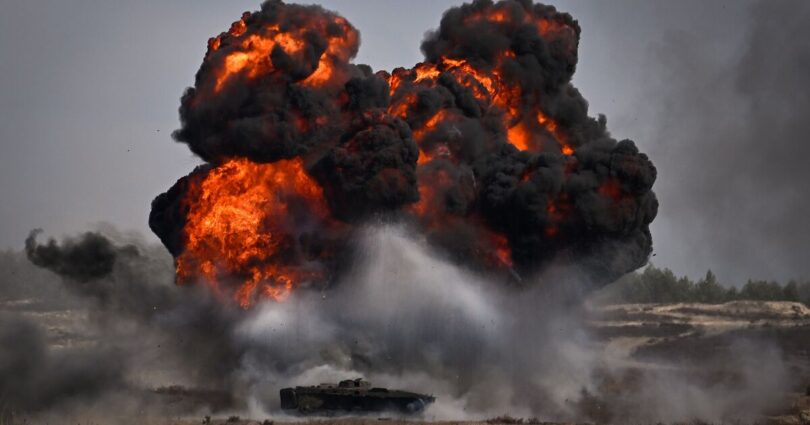
President Trump is weighing strikes to damage nuclear facilities and weaken supreme leader (Image: Getty)
President Trump has been presented in recent days with an expanded list of potential military options against Iran aimed at doing further damage to the country’s nuclear and missile facilities or weakening Iran’s supreme leader, according to multiple U.S. officials.
The options go beyond the proposals that Mr. Trump was considering two weeks ago as a means of following through on his promise to stop the killing of protesters by Iranian government security forces and affiliated militias, the officials said, speaking on the condition of anonymity to discuss potential military plans.
The current set of options even includes the potential for American forces to carry out raids on sites inside Iran, and it comes in a different context, now that the protests have been brutally quashed, at least for the time being.
Trump demands Iran halt nuclear programme
Mr. Trump has been demanding that Iran take further steps to end its push to build a nuclear weapon and halt its support for proxies that have long targeted Israel and destabilised the Middle East. He and his top aides are weighing whether to make good on his threats of military action to achieve those goals and possibly bring about a change in government.
Mr. Trump has not yet authorised military action or chosen among the options presented by the Pentagon, officials said. The president remains open to finding a diplomatic solution and some officials acknowledged that telegraphing the threats of military action was intended to drive the Iranians into a negotiation. In recent days, he has mulled over whether regime change would be a viable option.
« As the commander in chief of the world’s most powerful military, President Trump has many options at his disposal with regard to Iran, » Anna Kelly, a White House spokeswoman, said in a statement. « The president has stated he hopes that no action will be necessary, but the Iranian regime should make a deal before it is too late. »
Read more: Trump’s 6-word WW3 threat to Iran leaves one city subject to revenge
Read more: Iran deploys 1,000 drones as Trump’s warship armada heads to Gulf
Trump previously ruled out strikes after executions cancelled
Amid the protests that swept Iran weeks ago, the Trump administration weighed strikes against Iran’s nuclear program as well as hitting more symbolic targets, like the headquarters of the militia responsible for much of the crackdown on protests. Mr. Trump then abruptly ruled out military action at that point after Iranian authorities said they canceled hundreds of scheduled executions, and Israel and Arab nations asked the president to postpone any strikes.
Mr. Trump, officials say, is taking a similar approach to Iran as he did to Venezuela, where the United States amassed forces just off its coast for months as part of a pressure campaign to oust Nicolás Maduro, the country’s leader. Efforts to convince Mr. Maduro to leave Venezuela failed in that case, leading U.S. forces to attack the country and capture him. He and his wife are now being held for trial in a federal detention center in Brooklyn.
Officials sceptical Tehran would accept US demands
With Iran, officials remain skeptical that Tehran would accept the conditions the United States has outlined, reports The New York Post. They include a permanent end to all enrichment of uranium and giving up all of its current nuclear stockpiles, starting with the more than 960 pounds of uranium that has been enriched to near-bomb-grade levels.
However, even if the regime were willing to hand over the material – which does not seem likely – most of it, remains buried under the rubble created by the strikes in June.
For that reason, Mr. Trump is still weighing the range of options, which officials said could happen all together or in some combination.

Iran’s Arak reactor dome was previously hit with a precision airstrike (Image: Getty)
1. Commit ground operations
Among the riskiest would involve secretly sending in U.S. commandos to destroy or badly damage parts of the Iranian nuclear program not already damaged in the U.S. bombing last June. American forces have long practiced for specialised missions such as going into countries like Iran to target nuclear sites or other high-value targets.
While Mr. Trump has repeatedly said the nuclear program was « obliterated, » his own national security strategy, published in the Autumn, took a more measured view, saying that the attack in June « significantly degraded Iran’s nuclear program. »
Mr. Trump has expressed reservations in the past about sending in U.S. forces on the ground and has repeatedly mentioned President Jimmy Carter’s failed operation in 1980, to rescue 52 American hostages held in Iran, as a cause for caution. In a recent interview with The New York Times, Mr. Trump contrasted his successful operation in Venezuela with « Jimmy Carter crashing helicopters all over the place, » but officials who have discussed Iran with him say that the failure of that operation made a deep impression on the president.
2. Decapitate Iran’s leadership
Another option would be a series of strikes against military and other leadership targets that would cause such turmoil that it could create the conditions on the ground for Iranian security forces or other forces to remove the 86-year-old supreme leader, Ayatollah Ali Khamenei.
It is unclear in this option who would govern the country if the supreme leader were to be removed or whether any successor would be more open to dealing with the United States.
Mr. Trump is also partly motivated to strike Iranian leaders because of their efforts to try to assassinate him. Federal prosecutors in New York said last year that Iranian plotters had discussed a plan to kill Mr. Trump just before he was re-elected president.
3. Join Israel in striking missile programme
Israel is pressing for a third option: It wants the United States to join it in re-striking Iran’s ballistic missile program, which intelligence officials say Iran has largely rebuilt since Israel devastated the program in the 12-day war last June, the officials said.
Rear Adm. Ali Shamkhani, the head of a newly created body that oversees military operations in Iran, said on Wednesday that any strikes by the United States would be considered an act of war, and that Iran would respond forcefully and target Tel Aviv.
For that reason, Israeli officials are deeply concerned about Iran’s missile program, which can reach civilian and military targets across Israel.
Earlier this week, White House officials met with Maj. Gen. Shlomi Binder, the Israeli military intelligence chief, who briefed the administration on intelligence regarding Iran. The Saudi defense minister, Prince Khalid bin Salman, is also visiting Washington this week to meet with senior Trump administration officials.
U.S. officials emphasised that these and other options were still being refined and debated among Mr. Trump’s inner circle of top aides, and that there was no consensus yet on the ultimate objective of any military action.
Source link