
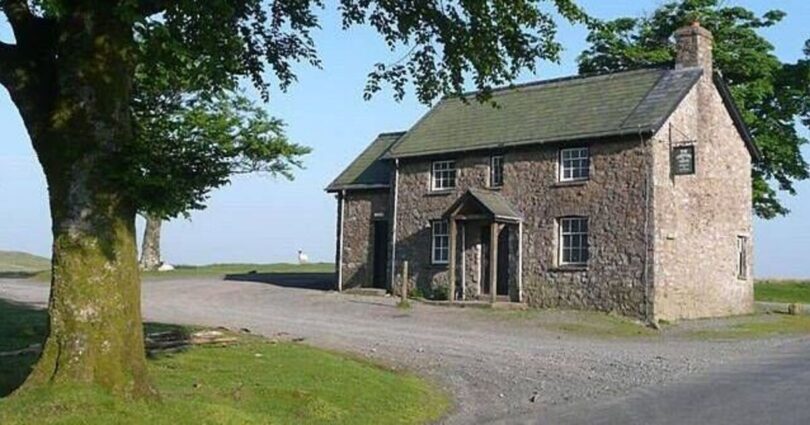
The Drovers Arms, once a pub, is one of the few buildings still standing (Image: Graham Horn/CC BY-SA 2.0)
Once a settlement of dozens of farms, a pub, cemetery and over 200 inhabitants whose forebears had farmed the land for generations, Epynt was reduced to silence within mere months. Its historic community vanished, leaving behind deserted homes and absent livestock. Most of the homes didn’t last much longer.
In September 1939, following the onset of World War Two, an Army officer arrived to survey this remote part of mid Wales. By Christmas, each farm (whose names the officer found difficult to pronounce) received notices, informing the stunned occupants they had until April 1940 to vacate their ancestral homes.
The Ministry of Defence had earmarked the area’s 30,000 acres as a training ground. The local populace was informed that their sacrifice was crucial to the war effort and they would be recompensed for their inconvenience.
With bombs already falling, the War Office was in dire need of additional land and facilities. For a fleeting moment in 1940, the predominantly Welsh-speaking community believed they had persuaded the MoD to rethink its plans. However, as Hitler’s Nazis rampaged across Europe, London dismissed the distressed community’s pleas, instructing them to seek new homes elsewhere to raise their families and tend their livestock, reports Wales Online.

Drain-duon (Black Thorn) Farm, from which William Thomas Price and Clara Price were ordered to leave (Image: Alan Richards/CC BY-SA 2.0)
Regrettably, the 54 farming families who were required to relocate had limited local alternatives and many were compelled to move away from the area. Many held the belief that this displacement would be temporary and they would return once the conflict ceased.
However, the MoD continues to this day to own the 30,000 acres of Mynydd Epynt, now known as the Sennybridge Training Area, which is still utilised for training and live firing by British soldiers.

Epynt was once a mountain community of 54 farms such as this (Image: WalesOnline)

Epynt’s Drover’s Arms pub in 1969 – standing isolated in the middle of the firing range (Image: WalesOnline)
Nearly all of the original structures, including the farmhouses, have been demolished — yet The Drovers Arms Inn pub remains standing, along with the gravestones in the cemetery. These are virtually the only remnants of the families who resided there 80 years ago in what was more a community than a clearly-defined village. Although satellite images on Google Maps reveal a small network of roads in the area, many are inaccessible via Street View.

Gravestones at Capel y Babell bear the names of those who once lived on Epynt (Image: Graham Horn/Creative Commons)

A plaque on the site of Capel y Babell, the main religious and community site when the Mynydd Epynt was populated (Image: Graham Horn/Creative Commons)
‘We’ve blown up the farmhouse — you won’t need to come here anymore’
In 1940, families held onto hope they would eventually remain – or at least return. As recently as March of that year, St David’s Day festivities took place at the chapel, known as Capel y Babell. One man, Thomas Morgan, was said to make regular journeys back to kindle a fire in his hearth, protecting the stonework from weather damage until his family’s anticipated homecoming. He maintained this daily ritual until two soldiers met him with devastating news: his home had been demolished. They informed him: « We’ve blown up the farmhouse. You won’t need to come here anymore. »

Members of Infantry Battle School take cover during a live firing exercise at the Sennybridge Training Area (Image: PA)

Am Epynt observation post at 409 metres, one of five around the edges of the Mynydd Epynt plateau at strategic locations. It is used by military commanders to check progress with manoeuvres. This area is often open to the public (Image: Graham Horn/CC BY-SA 2.0)
Bethan Price, a descendant of one of Epynt’s families, revealed her great-grandmother left a key in her front door lock, never abandoning hope of returning. However, others recognised the permanence of their departure. One woman even insisted on removing her front door when she departed the village. For countless residents it marked the conclusion of an era, their familiar world disappearing forever.
In June 1940 the school and chapel shut their doors, the Army began dismantling hedges, and on 1st July 1940, heavy artillery bombardment commenced. According to NFU Cymru, Elwyn Davies, aged 10 at the time, remembered his grandmother’s forced relocation, ultimately settling in Carmarthenshire: « It was a very sombre time. It was war time, and there weren’t many options locally. Just a week after she left, they flattened her house. They flattened everything. »
Iowerth Paete, who previously served as curator at St Fagans National Museum of History, was dispatched to document the event through his lens. He remembered witnessing horses dragging carts piled with belongings along the road leading from the village, and an elderly woman weeping as she sat in a chair outside the dwelling she was being compelled to abandon.
Current MP Ben Lake, whose grandmother Beryl Lake was the final infant born at Epynt, told NFU Cymru: « The takeover of the Epynt 80 years ago is a significant but often overlooked chapter in the history of Wales. An entire community was displaced, and families had to vacate farms that had been farmed by their ancestors for generations. »
Yet, notwithstanding the fury experienced at the time, voicing opposition was seen as undermining the war effort and the Allied struggle against Hitler. Consequently, the compulsory evacuation of Epynt never achieved the same historical prominence as, for instance, Capel Celyn in Tryweryn Valley, which was intentionally submerged in 1965 to supply drinking water to Liverpool households.

‘Remember Epynt’ graffiti painted on a bus stop in the same style as the iconic ‘Remember Tryweryn’ painting in Wales — despite the similarities in the Welsh communities’ displacement, Epynt has never had as wide an impact on Welsh culture and identity (Image: North Wales Live)
Indeed, eight decades later, Epynt’s legacy has diminished – rather like the inscriptions of its past inhabitants carved into the worn headstones at its 19th century chapel.
Can you visit Epynt today?

Across the top of the Epynt range (Image: undefined)

Looking north from the top of the Epynt road (Image: Simon Williams)
Visitors can explore the Epynt Way through various walking routes of differing distances where « sheep roam freely on artillery ranges and red kites soar above troops on exercises » but « the sound of the wind is punctuated by booming mortars ». The Epynt Way visitor centre, housed in a traditional farmhouse, offers guidance to visitors: « If you see any military debris, don’t worry, you are safe but please don’t pick things up. You may see soldiers training but you are more likely to see red kites, hares and other wildlife. »
Source link