Mount Everest is not a place for the faint of heart.
There have been at least 344 deaths on the mountain since records of climbing there began a century ago, and many of these bodies remain on the side of the famous peak. It is too dangerous to recover them, and the freezing temperatures stop the corpses from dissolving.
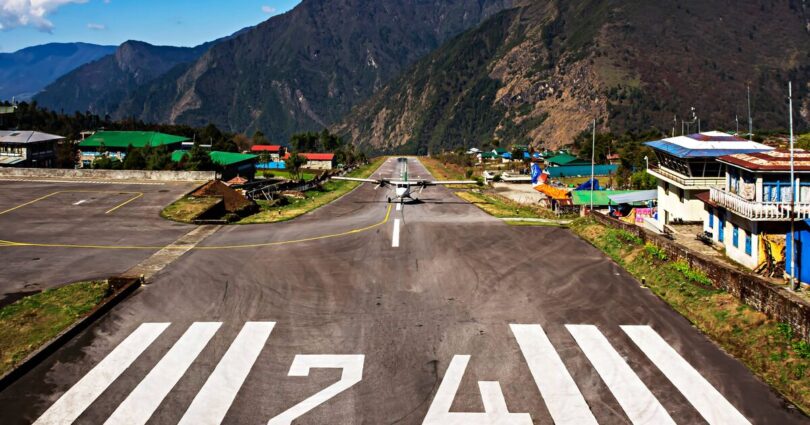
If that wasn’t enough to put you off a little jaunt to the world’s highest mountain, then having to fly into the world’s most dangerous airport might. Nestled nearly nine-and-a-half thousand feet above sea level and encircled by mountains, Tenzing-Hillary Airport, also known as Lukla Airport, in Nepal, holds a notorious reputation.
While runways at major airports typically span 7,000-10,000 feet, the runway at Tenzing-Hillary is a nerve-wrackingly brief 1,729 feet. This diminutive runway ends abruptly at the edge of a cliff, which features a daunting 2,000-foot drop on one side and a stone wall on the other.
Adding to the peril, Nepal’s unpredictable mountain weather makes this precarious runway even more hazardous. Pilots must be at their best when taking off from Tenzing-Hillary, as sudden snowfall or fog can make visibility very poor, when it doesn’t ground flights altogether.
It’s not uncommon for pilots to turn back to Kathmandu at the last minute when the weather takes a turn for the worse. Given the dangerously short runway, only small planes and helicopters are allowed to land at the airport. In fact, around half of the flights due to land at the airport turn back around during the monsoon season.
To tackle the temperamental travel hub, captains must undergo specialist training. This includes a minimum of 100 short take-offs and landings, a year of experience of flying in Nepal and 10 flawless flights to Tenzing-Hillary with an instructor.
Despite these precautions, the airport has a grim history of crashes. As recently as 2019, three people lost their lives when a plane veered off the runway and collided with a helicopter. In 2008, eight people perished when a plane attempted to land. These two incidents are among many that have befallen an airport with a justifiably fearsome reputation.
So why do people risk this perilous flight? The answer lies in the location of the airport. Situated in Lukla, at the base of the Mount Everest trek, it’s just a 40-minute journey from Kathmandu, whereas alternative routes, such as by bus or on foot, take considerably longer.
While there are many runways in the world that are difficult to tackle, Tenzing-Hillary manages to combine many of the factors that make them a challenge. Sometimes it’s the short runway, as on many Greek islands. Places like Gibraltar suffer from regular wind shear, while mountainous terrain surrounding airports like Innsbruck creates obvious risks. Airports at high altitudes present dangers due to the effect that low air pressure has on the handling of an airplane. Tenzing-Hillary has all of these issues.
Although far from being the world’s highest civilian airport – that honour goes to Daocheng Yading Airport in China’s Sichuan province – Lukla’s altitude is still more than enough to cause pilots problems. Air density drops dramatically at such altitudes, meaning the plane’s engine is less able to generate power, which in turn reduces lift. Reduced air resistance also makes it more challenging to slow the plane down.
At high altitudes, with limited plane control, long runways, and few obstacles (such as massive mountains), are ideal. Tenzing-Hillary delivers the exact opposite.
The airport traces its history back to Sir Edmund Hillary, the first person to climb Everest, along with Tenzing Norgay. Keen for others to avoid the same long trek he had to make to base camp, Hillary bought the land the airport currently sits on for $2,700., with the first flight landing there in 1971, Simply Flying reports.
Source link