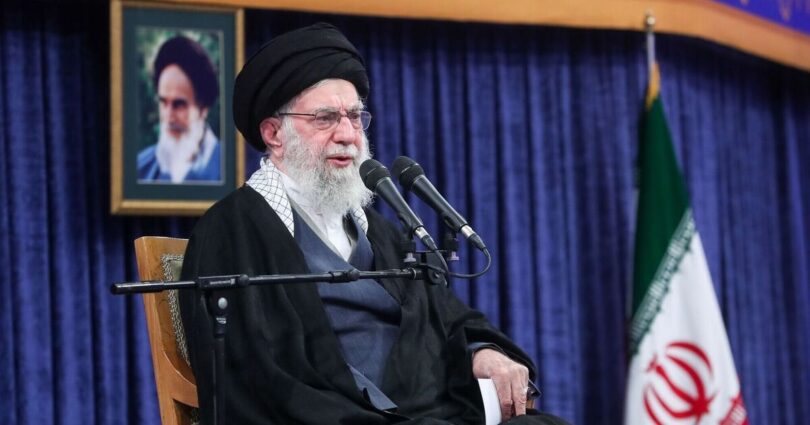
As deadly street protests against the Ayatollah in Iran entered their seventh day today, it emerged the failing Islamic regime was using a sophisticated campaign of disinformation and fake news to quell the riots.
At least eight people, one just 15-years-old, have so far died in street battles which began in Tehran on Sunday when businesses, furious at another catastrophic collapse the value of the Iranian currency, closed their doors and took to the streets. The protests quickly turned into calls to rid Iran of theocratic dictator Ayatollah Ali Khamenei and his ruling mullahs.
Tensions were ramped up further when US President Donald Trump warned the Iranian authorities he would come to the aid of peaceful protesters if the killings by the Iranian Revolutionary Guard (IRGC) continued. Posting on social media, he wrote: « We are locked and loaded and ready to go. »
It has emerged the once all-powerful IRGC have been beaten back in several confrontations in recent days, triggering the implementation of state-sponsored disinformation. State actors have been infiltrating protests and using deepfake videos online – in a bid to divide opposition voices and weaken the uprising.
Opponents of the regime say plainclothes IRGC agents have been sent into protest crowds to chant in favour of Reza Pahlavi (the son of the ousted Shah of Iran, deposed in the 1979 revolution), in an attempt to reframe the uprising as a monarchist movement rather than a rejection of the Ayatollahs’ dictatorship. Several videos from the protests appear to substantiate this claim.
An activist for the opposition National Council of Resistance of Iran said the tactic was intended to derail the protests from their true objective: demanding regime change by the Iranian people.
The NCRI is led by Maryam Rajavi, who has pledged to establish a democratic, secular, and non-nuclear Iran.
According to the activist, protest videos had been overdubbed with new soundtracks calling for the restoration of the Shah and posted widely online by state actors. He said: “Plainclothes IRGC agents were sent into the crowds to chant in favour of Reza Pahlavi, attempting to hijack the anti-regime movement by insinuating that its real goal was restoring the monarchy, thereby creating discord and diluting the demand for the regime’s overthrow.
“In every case, protesters rejected these provocations, responding with chants against both the Shah and the Supreme Leader. In one instance, individuals identified as IRGC affiliates were caught on video engaging in this ploy.”
In one widely shared incident, individuals later identified as IRGC affiliates were filmed attempting to steer chants toward monarchy restoration. An Iranian Kurdish activist wrote on X that IRGC units in Marivan had instructed their operatives to chant pro-Pahlavi slogans if protests erupted, warning citizens to remain vigilant. Similar tactics were reported weeks earlier in Mashhad, where plainclothes agents infiltrated the funeral of an anti-regime lawyer who died under suspicious circumstances. After chanting pro-monarchy slogans to disrupt the ceremony, they joined security forces in arresting mourners. Protesters who confronted them seized identification cards revealing they were members of the Basij paramilitary force.
Experts say many social media posts have exposed doctored videos in which original protest footage was overlaid with fabricated audio suggesting support for the Shah’s son, Reza Pahlavi. Analyses of these clips revealed mismatched acoustics, lip-sync errors, and crowd behaviour inconsistent with the added audio.
The activist added that the current uprising is not merely a reaction to economic hardship but a sweeping rejection of dictatorship in all its forms. Despite the regime’s attempts to fracture unity through infiltration, disinformation, and deepfake propaganda, the dominant message from the streets remains clear: Iranians are demanding freedom, equality, and an end to authoritarian rule.
Source link