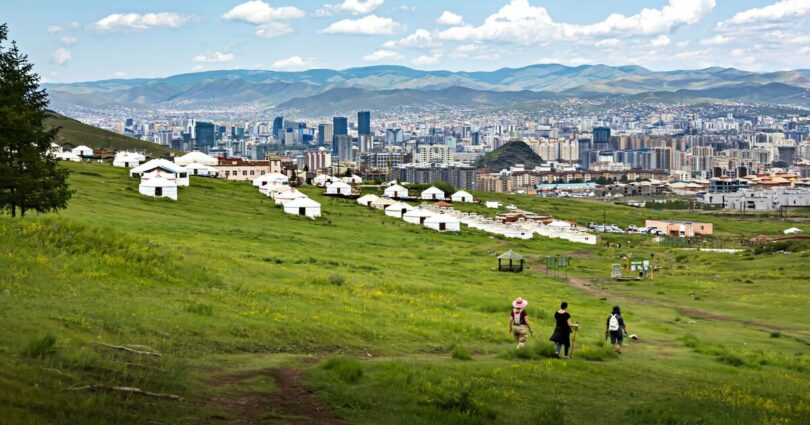
The world is full of beautiful destinations that have traits which make them completely unique, and it just so happens that this one is renowned for having a vast land area but being practically empty. Mongolia covers more than 603,000 square miles, yet the country is home to just around 3.5 million people, making it the world’s most sparsely populated sovereign state.
In fact, the country, often described as empty, has a significant number of its residents residing in Ulaanbaatar, the capital. Approximately 99.7% of the country’s territory is uninhabited, with the population density being around two people per square kilometre, or five to six per square mile.
The majority of Mongolia’s geography is made up of grassy steppe (grassland plains without closed forests). Mountains dominated the north and west, while the Gobi Desert is found in the south.
However, the diverse landscapes, along with their cold climate, make it difficult for citizens to have stable living conditions. In fact, a nomadic lifestyle is a long-rooted tradition within Mongolia. The tradition centres on herding animals and moving seasonally in portable homes known as gers. Residents do this in order to find fresh pasture.
Though climate change and urbanisation have made it harder in the modern day, 30% of the population remains nomadic or semi-nomadic.
Horse culture is also a crucial aspect of Mongolia’s heritage. Mongolia is home to more than five million horses, which outnumbers the country’s human population.
It’s said that « A Mongol without a horse is like a bird without wings » – the animals play a significant role in the use for daily work and horse racing. The milk of mares is also processed into the country’s national beverage, airag, a traditional, slightly alcoholic, fermented dairy drink.
While the emptiness of Mongolia is what it is often known for today. The huge landlocked country has a fascinating history, which includes it once founding the largest contiguous land empire in world history.
The Mongol Empire, founded by Genghis Khan, emerged from the unification of various nomadic tribes and stretched from the Sea of Japan to Eastern Europe.
Conflict over succession caused the empire to begin to split, and by the late 13th century, the Yuan dynasty (a successor of the Mongol Empire) was overthrown by the Chinese-led Ming Dynasty. After periods of occupation, Mongolia gained complete independence from the Republic of China in 1921.
Source link