
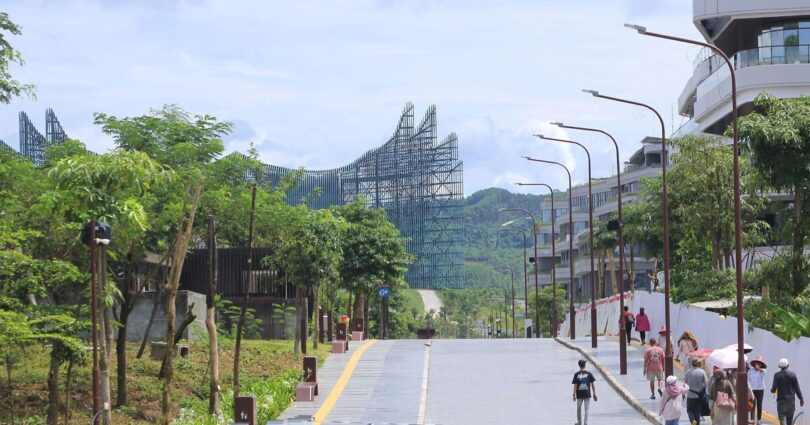
Located deep in the forests of East Kalimantan on Borneo Island, Indonesia‘s futuristic new political capital rises like a vision of modern ambition and is expected to be fully completed by 2028. Motorways cut through the jungle, leading to soaring Government buildings and the presidential Garuda Palace, its iconic winged design gleaming in the tropical sun. Yet, despite the grandeur, the streets of Nusantara, the £26.2 billion city, remain largely deserted.
Three years after former President Joko Widodo unveiled the multi-billion-dollar project aimed at replacing the overcrowded city of Jakarta, which has now been crowned the largest city on the planet, with a population of 42 million and also the fastest-sinking city in the world. Construction on the city began three years ago, and by 2045, the capital is expected to be twice the size of New York City, but designed to produce zero carbon emissions.
Nearly every aspect of urban life is expected to be powered by solar energy, from street lighting to electric buses.
However, under President Prabowo Subianto, who took office in October 2024, government funding for the new capital has been slashed from £2bn in 2024 to £700m in 2025, with only £300m earmarked for 2026.
Cutting-edge technology is set to be at the heart of the city’s operations, with biometric scanners monitoring access throughout public buildings, and artificial intelligence will manage everything from traffic flow to energy consumption.
Private investment has also fallen well short of expectations, leaving construction slowed and the city far from its original target of 1.2 million residents by 2030, The Guardian reported.
Earlier this year, in May 2025, Nusantara was downgraded from national capital city to « political capital, » a change made public only in September.
Currently, roughly 2,000 civil servants and 8,000 construction workers live in the city, a small fraction of the intended population. While apartments, ministry buildings, hospitals, roads, and even an airport have been completed, large sections of Nusantara reportedly remain under construction.
Herdiansyah Hamzah, a constitutional law scholar at Mulawarman University, argued the city is already « a ghost city, » and that the political capital label carries no real legal weight.
Officials, on the other hand, remain optimistic. Basuki Hadimuljono, head of the Nusantara Capital Authority, insists the government’s commitment has not wavered. He added that the funding has been « reallocated », not « cut. »
Environmental concerns add another layer of complexity. The construction of roads, ports, and infrastructure has cleared over 2,000 hectares of mangrove forest, according to the NGO Walhi. Local Indigenous communities, including the Balik people along the Sepaku River, report increased flooding and reduced access to clean water since nearby treatment facilities were built.
The government, meanwhile, has denied these claims and defended the project, stating that only a quarter of the 252,000-hectare site will be developed, with the rest preserved as green space.
Officials argue the city could eventually ease the economic and political dominance of Java, Indonesia’s most populated island, while also serving as a showcase for Indonesia’s vision of a sustainable, « smart forest » city.
Source link